Dandelion Juice
Traditionally Used For
- Acne
- Anemia
- Bladder Problems
- Bone Problems
- Circulation
- Constipation
- Eye Problems
- Kidneys
- Liver
- Skin
- Weight Loss
A Good Source Of
- Calcium
- Iron
- Potassium
- Sodium
- Magnesium
- Vitamin A
- Vitamin B–1
Freshness Test
Dandelions grow like a weed and many consider them a weed. But to me, they are not a weed and in fact, are one of my favorite greens.
When picking dandelion leaves, choose small leaves. The larger the leaf, the more bitter the taste. Dandelion leaves are best picked in the spring but you can pick them all summer too. Avoid picking leaves in the areas where chemical fertilizers or pesticides have been used.
I pick dandelion leaves from my backyard as I use no chemicals in the yard. Some pick dandelion leaves from fields. Try to avoid picking leaves that are close to roads and especially highways.
Important
Due to the fact that Dandelion Greens are a green juice, you will find it beneficial to have no more than about ¼ of your juice consisting of green juice.
Dandelion is very concentrated and so I try not use to any more than 1 ounce in every 8 ounce glass.
General
When I was a child, I used to have stinging nettle soup all the time (and I must say, it was delicious). Both stinging nettle and dandelion leaves are traditional herbal remedies which have stood the test of time. This is definitely one of my favorite herbs.
In the fall, I like to dig up dandelion roots and juice them. The roots are bitter and thus need to be mixed with other vegetables. Dandelion roots are best picked in the fall (September onwards) and dandelion greens are best picked in the spring. Of course, you can pick roots and leaves all year if you want. But spring and fall are the best for the leaves and roots respectively.
Dandelion roots are a tap root like carrots and parsnip. I unfortunately don't have the nutritional analysis for dandelion roots otherwise I would have added it.
Both Dandelion roots and greens have been used by herbalists for centuries. Traditionally dandelion roots and greens have been used to help support the liver.
Dandelion leaves are exceptionally high in nutrition especially calcium, iron along with a host of other nutrients. If you are able to grow dandelion leaves and/or get some from your local grocery store (many grocery stores now sell organic dandelion leaves), then do consider using some dandelion leaves in your favorite juice recipe.
You might find it beneficial to alternate between dandelion leaves and arugula leaves. Both dandelion leaves and arugula are very high in nutrition. Both have similar effects or benefits yet because they are a different food / vegetable, the body will appreciate the variety.
While both dandelion leaves and arugula leaves are very high in nutrition, stinging nettle are probably an even better source of nutrition, especially calcium. But unfortunately, at this time, it is more difficult to get stinging nettle unless you are able to pick them yourself.
Chinese Herbal Information
Properties:
Energy: cold
5 Elements: wood,fire
5 Flavors: sour,bitter
General Information:
Nothing to report.
Cautions & Suggestions:
Nothing to report.
Benefits:
Nothing to report.
Herbal and Homeopathic Remedies That You Might Like
I have personally been using herbal and homeopathic remedies with great success since 1992. So like me, you might find that in addition to juicing, the following herbal and/or homeopathic remedies may be beneficial in helping you achieve greater and better health.
→ Don't see the right remedy for you? View a wide selection of more herbal and homeopathic remedies for various health concerns.
- Pet Acne Clear
Homeopathic medicine for symptoms of dog and cat acne.
- MediAc
Homeopathic remedy reduces acne including blackheads and whiteheads on the face and body.
Picture of a Dandelion Flower and Leaves
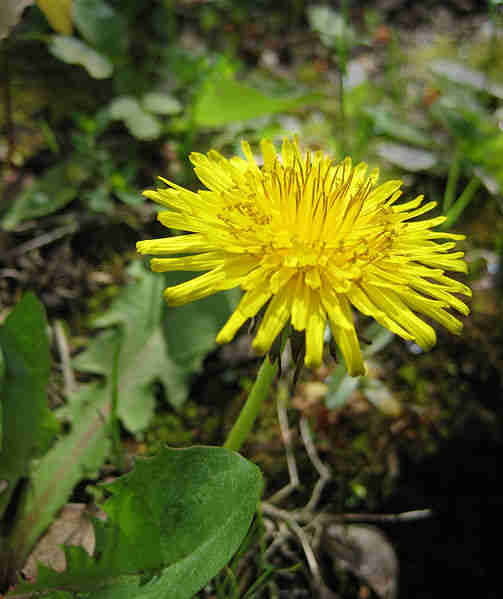
Photo by Eric Baetscher.
Sponsored Links
Dandelion Leaves — Nutritional Analysis
- Nutrient
- Units
- Value / 100 g
- Proximates
- Water
- g
- 85.60
- Energy
- kcal
- 45
- Energy
- kj
- 188
- Protein
- g
- 2.70
- Total lipid (fat)
- g
- 0.70
- Ash
- g
- 1.80
- Carbohydrate, by difference
- g
- 9.20
- Fiber, total dietary
- g
- 3.5
- Minerals
- Calcium, Ca
- mg
- 187
- Iron, Fe
- mg
- 3.10
- Magnesium, Mg
- mg
- 36
- Phosphorus, P
- mg
- 66
- Potassium, K
- mg
- 397
- Sodium, Na
- mg
- 76
- Zinc, Zn
- mg
- 0.41
- Copper, Cu
- mg
- 0.171
- Manganese, Mn
- mg
- 0.342
- Selenium, Se
- mcg
- 0.5
- Vitamins
- Vitamin C, total ascorbic acid
- mg
- 35.0
- Thiamin
- mg
- 0.190
- Riboflavin
- mg
- 0.260
- Niacin
- mg
- 0.806
- Pantothenic acid
- mg
- 0.084
- Vitamin B-6
- mg
- 0.251
- Folate, total
- mcg
- 27
- Folic acid
- mcg
- 0
- Folate, food
- mcg
- 27
- Folate, DFE
- mcg_DFE
- 27
- Vitamin B-12
- mcg
- 0.00
- Vitamin A, IU
- IU
- 14000
- Retinol
- mcg
- 0
- Vitamin A, RAE
- mcg_RAE
- 700
- Vitamin E
- mg_ATE
- 2.500
Have you been wanting to do hatha yoga (stretching) but have found it either too difficult or you are not that flexible? If yes, and even if no, watch Jesse do some pure hatha yoga routines.
Unlike flow yoga
, each pose in pure or traditional hatha yoga is held for a few minutes. While holding the pose, you focus the mind on the stretch. When you focus the mind, that's when you find silence.
Jesse is not flexible — never has been and probably never will be flexible like others. But it doesn't matter. In pure hatha yoga, how flexible you are makes no difference. It's all about loving the pose and focussing the mind on the stretch.
If you want to learn pure hatha yoga, now you can by following Jesse on a series of hatha yoga routines.
Sponsored Links
Random Questions That Have Been Asked:
- Can I juice carrot greens?
- Putting Vegetables On Ice Before Juicing
- Blanching vegetables before freezing
- Can the body detoxify too fast?
- What Vegetables or Fruits Can Help With Soft Stools or Diarrhea?
- How important is a slow speed juicer compared to fast speed?
- What are good juicing combinations? What juicing combinations should be avoided?
- Can I drink more than 1/2 pint (1 cup) of juice per day?
- Hypoglycemia, General Detox and Colds
- Please comment on a report that says beet juice can improve exercise endurance?