Raspberry Juice
Traditionally Used For
- Anti–Oxidants
- Cancer
- Heart
- High Cholesterol
- Insomnia
- Weight Loss
A Good Source Of
- Copper
- Manganese
- Magnesium
- Potassium
- Vitamin B3
- Vitamin C
Freshness Test
It's relatively simple to determines if the raspberries are fresh — simply look at them. If you see they look damaged or no longer fresh, then they probably are. Ultimately, you just want raspberries that are firm, plump and have a nice deep red color to them. Raspberries spoil relatively quick so just buy what you need or pick what you need and then either freeze them or use within a day or two.
Important
Nothing to report.
General
Raspberries can often be found growing in the wild, in parks, etc and so you can pick them if you want. Some farms offer you the ability to pick your own — this method is known as "U–Pick". In addition to raspberries, many farms also allow you to pick blueberries, etc. When picking raspberries yourself, always remember to choose the berries higher up — why? Well, let's face it, dogs and other animals are known to "water the plants" and so if you choose raspberries grown lower to the ground, then they may come with extra, albeit unwanted, flavorings!
Raspberries are best picked in August but can be found, depending on the climate, from June to October.
Chinese Herbal Information
Properties:
Energy: warm
5 Elements: wood,earth
5 Flavors: sour,sweet
General Information:
Nothing to report.Cautions & Suggestions:
Chinese herbalists traditionally mix raspberry juice with honey to help alleviate a dry cough due to a cold.
Chinese herbalists also use the unripe (green) raspberry in traditional Chinese herbal medicine to help the kidneys, liver, female sex hormones and other problems. But if using an unripe raspberry it is best to consult a Chinese herbalist.
Benefits:
- Frequent Urination
- Liver
- Kidneys
- Motion Sickness
Herbal and Homeopathic Remedies That You Might Like
I have personally been using herbal and homeopathic remedies with great success since 1992. So like me, you might find that in addition to juicing, the following herbal and/or homeopathic remedies may be beneficial in helping you achieve greater and better health.
→ Don't see the right remedy for you? View a wide selection of more herbal and homeopathic remedies for various health concerns.
- BladderWell Pellets
Homeopathic medicine for burning and frequent urination, plus improving bladder health.
- Blood Sugar Balance ComboPack
Homeopathic medicine Triple Complex Glucose Control for sugar imbalances in the blood and herbal supplement Insulate Plus for pancreatic and endocrine system health.
- Bio-Oxidate Defense
Promotes cell integrity & anti-aging with natural antioxidants to discourage cell damage due to lifestyle factors - now with Resveratrol.
- AllergiClear
Helps keep histamine levels in the normal range for optimal respiratory health.
- Healthy Veins ComboPack
Homeopathic medicine VaricoGo for symptoms of varicose veins and Herbal supplement Circu-Live for circulatory health.
Picture of Raspberries
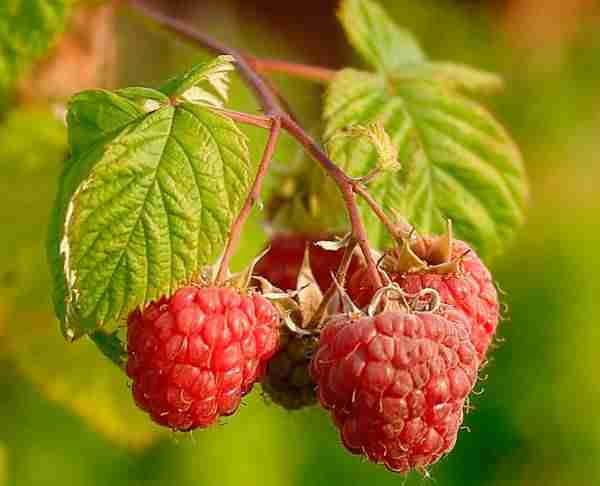
Photo by Juhanson.
Sponsored Links
Raspberry — Nutritional Analysis
- Nutrient
- Units
- Value / 100 g
- Proximates
- Water
- g
- 85.75
- Energy
- kcal
- 52
- Energy
- kJ
- 220
- Protein
- g
- 1.20
- Total lipid (fat)
- g
- 0.65
- Ash
- g
- 0.46
- Carbohydrate, by difference
- g
- 11.94
- Fiber, total dietary
- g
- 6.5
- Sugars, total
- g
- 4.42
- Sucrose
- g
- 0.20
- Glucose (dextrose)
- g
- 1.86
- Fructose
- g
- 2.35
- Lactose
- g
- 0.00
- Maltose
- g
- 0.00
- Galactose
- g
- 0.00
- Starch
- g
- 0.00
- Minerals
- Calcium, Ca
- mg
- 25
- Iron, Fe
- mg
- 0.69
- Magnesium, Mg
- mg
- 22
- Phosphorus, P
- mg
- 29
- Potassium, K
- mg
- 151
- Sodium, Na
- mg
- 1
- Zinc, Zn
- mg
- 0.42
- Copper, Cu
- mg
- 0.090
- Manganese, Mn
- mg
- 0.670
- Selenium, Se
- mcg
- 0.2
- Vitamins
- Vitamin C, total ascorbic acid
- mg
- 26.2
- Thiamin
- mg
- 0.032
- Riboflavin
- mg
- 0.038
- Niacin
- mg
- 0.598
- Pantothenic acid
- mg
- 0.329
- Vitamin B-6
- mg
- 0.055
- Folate, total
- mcg
- 21
- Folic acid
- mcg
- 0
- Folate, food
- mcg
- 21
- Folate, DFE
- mcg_DFE
- 21
- Choline, total
- mg
- 12.3
- Betaine
- mg
- 0.8
- Vitamin B-12
- mcg
- 0.00
- Vitamin B-12, added
- mcg
- 0.00
- Vitamin A, RAE
- mcg_RAE
- 2
- Retinol
- mcg
- 0
- Carotene, beta
- mcg
- 12
- Carotene, alpha
- mcg
- 16
- Cryptoxanthin, beta
- mcg
- 0
- Vitamin A, IU
- IU
- 33
- Lycopene
- mcg
- 0
- Lutein + zeaxanthin
- mcg
- 136
- Vitamin E (alpha-tocopherol)
- mg
- 0.87
- Vitamin E, added
- mg
- 0.00
- Tocopherol, beta
- mg
- 0.06
- Tocopherol, gamma
- mg
- 1.42
- Tocopherol, delta
- mg
- 1.04
- Vitamin K (phylloquinone)
- mcg
- 7.8
- Lipids
- Fatty acids, total saturated
- g
- 0.019
- 4:0
- g
- 0.000
- 6:0
- g
- 0.000
- 8:0
- g
- 0.000
- 10:0
- g
- 0.000
- 12:0
- g
- 0.000
- 14:0
- g
- 0.000
- 16:0
- g
- 0.016
- 18:0
- g
- 0.004
- Fatty acids, total monounsaturated
- g
- 0.064
- 16:1 undifferentiated
- g
- 0.000
- 18:1 undifferentiated
- g
- 0.059
- 20:1
- g
- 0.005
- 22:1 undifferentiated
- g
- 0.000
- Fatty acids, total polyunsaturated
- g
- 0.375
- 18:2 undifferentiated
- g
- 0.249
- 18:3 undifferentiated
- g
- 0.126
- 18:4
- g
- 0.000
- 20:4 undifferentiated
- g
- 0.000
- 20:5 n-3
- g
- 0.000
- 22:5 n-3
- g
- 0.000
- 22:6 n-3
- g
- 0.000
- Cholesterol
- mg
- 0
- Other
- Alcohol, ethyl
- g
- 0.0
- Caffeine
- mg
- 0
- Theobromine
- mg
- 0
Have you been wanting to do hatha yoga (stretching) but have found it either too difficult or you are not that flexible? If yes, and even if no, watch Jesse do some pure hatha yoga routines.
Unlike flow yoga
, each pose in pure or traditional hatha yoga is held for a few minutes. While holding the pose, you focus the mind on the stretch. When you focus the mind, that's when you find silence.
Jesse is not flexible — never has been and probably never will be flexible like others. But it doesn't matter. In pure hatha yoga, how flexible you are makes no difference. It's all about loving the pose and focussing the mind on the stretch.
If you want to learn pure hatha yoga, now you can by following Jesse on a series of hatha yoga routines.
Sponsored Links
Random Questions That Have Been Asked:
- How often should I juice to get enough nutrition?
- Do you have any tips for Cystic Fibrosis, asthma and respiratory illnesses?
- How Can I Help Reverse Acne For My Son?
- Is It Okay To Mix Apples With Vegetable Juice?
- Warts and Juicing
- How Much Nutrition Is In Pulp?
- Does pickling remove the benefits?
- Can the body detoxify too fast?
- What can I juice or do to help with my excessive sweating (hyperhidrosis)?
- Do you have a recipe that includes pears and beets?