Asparagus Juice
Traditionally Used For
- Anemia
- Blood Purifier
- Bowel Aid
- Eye Problems
- Gout
- Kidneys
- Nervous System
- Prostate
- Rheumatism
- Skin Problems
A Good Source Of
- Potassium
- Vitamin A
- Vitamin B–1
- Vitamin C
- Choline
- Folic Acid
Freshness Test
Asparagus is best when bought in season (April to June) but is now widely available throughout the year. You can grow asparagus yourself too, although it does take time for asparagus to really produce a crop.
Look for firm but tender asparagus. You can buy either thick or thin stemmed asparagus.
Fresh asparagus is purple at the top.
Important
Asparagus is a natural diuretic. It has been known to make urine go dark and to smell strong which is perfectly natural and will soon pass.
Due to the fact that asparagus is a green juice, you will find it beneficial to have no more than about ¼ of your juice consisting of green juice.
Some individuals may find that too much asparagus juice can be irritating to the kidneys, especially if you have kidney inflammation.
General
Some of the nutrients in asparagus are damaged when cooking. So when you drink fresh asparagus juice you are getting nutrients that you don't normally get.
Personally, I don't like eating asparagus but I must admit, I do like my asparagus juice!
Chinese Herbal Information
Properties:
Energy: warm
5 Elements: fire,metal
5 Flavors: bitter,spicy
General Information:
Nothing to report.
Cautions & Suggestions:
Nothing to report.
Benefits:
- Coughs
- Diuretic
- Mucous Discharge
- Skin Eruptions
- Swellings
Picture of Asparagus
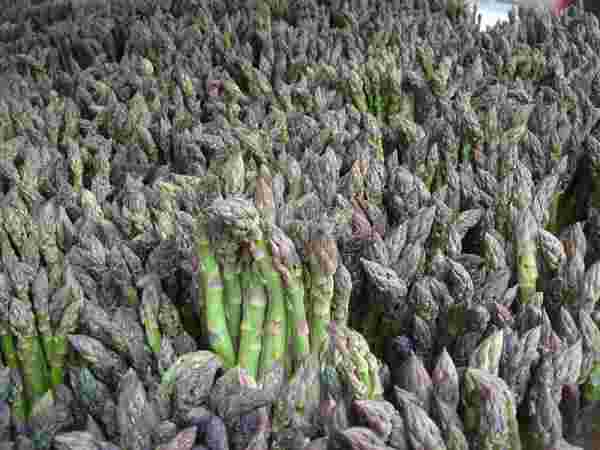
Notice how the tops of the asparagus are purple. A sign the asparagus is fresh.
Photo by Ryan Freisling.
Sponsored Links
Asparagus — Nutritional Analysis
- Nutrient
- Units
- Value / 100 g
- Proximates
- Water
- g
- 92.40
- Energy
- kcal
- 23
- Energy
- kj
- 96
- Protein
- g
- 2.28
- Total lipid (fat)
- g
- 0.20
- Ash
- g
- 0.57
- Carbohydrate, by difference
- g
- 4.54
- Fiber, total dietary
- g
- 2.1
- Minerals
- Calcium, Ca
- mg
- 21
- Iron, Fe
- mg
- 0.87
- Magnesium, Mg
- mg
- 18
- Phosphorus, P
- mg
- 56
- Potassium, K
- mg
- 273
- Sodium, Na
- mg
- 2
- Zinc, Zn
- mg
- 0.46
- Copper, Cu
- mg
- 0.176
- Manganese, Mn
- mg
- 0.262
- Selenium, Se
- mcg
- 2.3
- Vitamins
- Vitamin C, total ascorbic acid
- mg
- 13.2
- Thiamin
- mg
- 0.140
- Riboflavin
- mg
- 0.128
- Niacin
- mg
- 1.170
- Pantothenic acid
- mg
- 0.174
- Vitamin B-6
- mg
- 0.131
- Folate, total
- mcg
- 128
- Folic acid
- mcg
- 0
- Folate, food
- mcg
- 128
- Folate, DFE
- mcg_DFE
- 128
- Vitamin B-12
- mcg
- 0.00
- Vitamin A, IU
- IU
- 583
- Retinol
- mcg
- 0
- Vitamin A, RAE
- mcg_RAE
- 29
- Vitamin E
- mg_ATE
- 2.000
- Amino Acids
- Tryptophan
- g
- 0.022
- Threonine
- g
- 0.064
- Isoleucine
- g
- 0.084
- Leucine
- g
- 0.099
- Lysine
- g
- 0.108
- Methionine
- g
- 0.022
- Cystine
- g
- 0.027
- Phenylalanine
- g
- 0.054
- Tyrosine
- g
- 0.036
- Valine
- g
- 0.088
- Arginine
- g
- 0.107
- Histidine
- g
- 0.035
- Alanine
- g
- 0.107
- Aspartic acid
- g
- 0.265
- Glutamic acid
- g
- 0.374
- Glycine
- g
- 0.074
- Proline
- g
- 0.121
- Serine
- g
- 0.087
Have you been wanting to do hatha yoga (stretching) but have found it either too difficult or you are not that flexible? If yes, and even if no, watch Jesse do some pure hatha yoga routines.
Unlike flow yoga
, each pose in pure or traditional hatha yoga is held for a few minutes. While holding the pose, you focus the mind on the stretch. When you focus the mind, that's when you find silence.
Jesse is not flexible — never has been and probably never will be flexible like others. But it doesn't matter. In pure hatha yoga, how flexible you are makes no difference. It's all about loving the pose and focussing the mind on the stretch.
If you want to learn pure hatha yoga, now you can by following Jesse on a series of hatha yoga routines.
Sponsored Links
Random Questions That Have Been Asked:
- How important is a slow speed juicer compared to fast speed?
- Do you have some tips for IBS, constipation and gallstones?
- Is It Okay To Mix Apples With Vegetable Juice?
- Juice Combination For Liver, Kidneys, Bile and Overall Health
- What juice will clean my colon of old fecal matter?
- Putting Vegetables On Ice Before Juicing
- Should I peel beets for juicing them or just wash them?
- What can help with my hemorrhoids, fissures and inflammation?
- Is Eating Whole Fruit Okay Even Though It Is High In Sugar?
- What Vegetables or Fruits Can Help With Soft Stools or Diarrhea?