Ginger Juice
Traditionally Used For
- Colds
- Digestive System
- Expectorant
- Immune System
- Mucous
A Good Source Of
- Potassium
Freshness Test
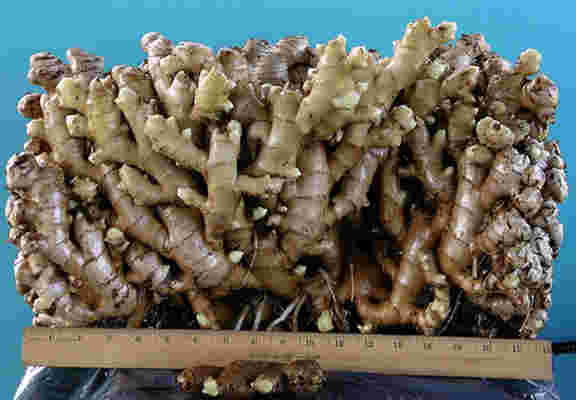
Ginger is a bumpy root. The ends are normally dry, but that's okay. If you cut off the ends, you get to the juicy part. Only buy as much Ginger as you need. If the Ginger Root in the store is too big, simply break off the amount that you need.
Important
I only use about 1 cm of Ginger Root at a time. Its taste is powerful.
General
Ginger Root does have a strong taste, but it's one of my favorites! I really enjoy Ginger Root juice, especially when combined with the standard blend apple juice and carrot juice.
Chinese Herbal Information
Properties:
Energy: warm
5 Elements: metal
5 Flavors: spicy
General Information:
Nothing to report.
Cautions & Suggestions:
Traditionally, fresh tender ginger is used in cooking while fresh older ginger is used for its therapeutic benefits in China. Fresh ginger is sometimes referred to as "baby ginger" and is often available in Chinese stores in June and July as it is a seasonal product.
Old ginger, also known as "mother ginger", is also available in Chinese stores but is difficult to chew.
Benefits:
- Arthritis
- Asthma
- Circulation
- Cough
- Diarrhea
- Digestion
- Flu
- Induces Perspiration
- Lungs
- Mucus
- Nausea
- Phlegm
- Rheumatism
- Spleen
- Stomach
- Swelling and Stiffness in Joints
- Vomiting
Picture of Ginger
Sponsored Links
Ginger — Nutritional Analysis
- Nutrient
- Units
- Value / 100 g
- Proximates
- Water
- g
- 81.67
- Energy
- kcal
- 69
- Energy
- kj
- 289
- Protein
- g
- 1.74
- Total lipid (fat)
- g
- 0.73
- Ash
- g
- 0.77
- Carbohydrate, by difference
- g
- 15.09
- Fiber, total dietary
- g
- 2.0
- Minerals
- Calcium, Ca
- mg
- 18
- Iron, Fe
- mg
- 0.50
- Magnesium, Mg
- mg
- 43
- Phosphorus, P
- mg
- 27
- Potassium, K
- mg
- 415
- Sodium, Na
- mg
- 13
- Zinc, Zn
- mg
- 0.34
- Copper, Cu
- mg
- 0.226
- Manganese, Mn
- mg
- 0.229
- Selenium, Se
- mcg
- 0.7
- Vitamins
- Vitamin C, total ascorbic acid
- mg
- 5.0
- Thiamin
- mg
- 0.023
- Riboflavin
- mg
- 0.029
- Niacin
- mg
- 0.700
- Pantothenic acid
- mg
- 0.203
- Vitamin B-6
- mg
- 0.160
- Folate, total
- mcg
- 11
- Folic acid
- mcg
- 0
- Folate, food
- mcg
- 11
- Folate, DFE
- mcg_DFE
- 11
- Vitamin B-12
- mcg
- 0.00
- Vitamin A, IU
- IU
- 0
- Retinol
- mcg
- 0
- Vitamin A, RAE
- mcg_RAE
- 0
- Vitamin E
- mg_ATE
- 0.260
- Amino Acids
- Tryptophan
- g
- 0.012
- Threonine
- g
- 0.036
- Isoleucine
- g
- 0.051
- Leucine
- g
- 0.074
- Lysine
- g
- 0.057
- Methionine
- g
- 0.013
- Cystine
- g
- 0.008
- Phenylalanine
- g
- 0.045
- Tyrosine
- g
- 0.020
- Valine
- g
- 0.073
- Arginine
- g
- 0.043
- Histidine
- g
- 0.030
- Alanine
- g
- 0.031
- Aspartic acid
- g
- 0.208
- Glutamic acid
- g
- 0.162
- Glycine
- g
- 0.043
- Proline
- g
- 0.041
- Serine
- g
- 0.045
Have you been wanting to do hatha yoga (stretching) but have found it either too difficult or you are not that flexible? If yes, and even if no, watch Jesse do some pure hatha yoga routines.
Unlike flow yoga
, each pose in pure or traditional hatha yoga is held for a few minutes. While holding the pose, you focus the mind on the stretch. When you focus the mind, that's when you find silence.
Jesse is not flexible — never has been and probably never will be flexible like others. But it doesn't matter. In pure hatha yoga, how flexible you are makes no difference. It's all about loving the pose and focussing the mind on the stretch.
If you want to learn pure hatha yoga, now you can by following Jesse on a series of hatha yoga routines.
Sponsored Links
Random Questions That Have Been Asked:
- Can I freeze the juice and drink it later?
- Is It Okay To Mix Apples With Vegetable Juice?
- What can I juice or do to help with my excessive sweating (hyperhidrosis)?
- What juice will clean my colon of old fecal matter?
- Juicing and Detoxification
- I Got Ill, For A Short Time, While Juicing
- What are good juicing combinations? What juicing combinations should be avoided?
- Hypolycemia — blurred vision and tiredness while juicing.
- What Vegetables or Fruits Can Help With Soft Stools or Diarrhea?
- Is Eating Whole Fruit Okay Even Though It Is High In Sugar?