Swiss Chard Juice
Traditionally Used For
- Anemia
- Antioxidant
- Blood Pressure
- Bones
- Eyes
- Muscle Relaxant
A Good Source Of
- Iron
- Vitamin A
- Vitamin C
Freshness Test
I prefer smaller leaves as the larger the leaves, the more bitter the taste. Look for fresh looking leaving with no or minimal discoloration.
The Swiss Chard season is from June to August.
Important
Due to the fact that Swiss Chard is a green juice, you will find it beneficial to have no more than about ¼ of your juice consisting of green juice.
Swiss Chard is very concentrated and so I try not use to any more than 1 ounce in every 8 ounce glass.
Swiss Chard is high in oxalic acid. Therefore should be avoided by those who suffer from or are at risk for kidney stones, gout, rheumatoid arthritis, osteoporosis and those whose stomach is easily irritated. Read my notes on oxalic acid for more information.
Since Swiss Chard is high in oxalic acid, you should also avoid combining Swiss Chard with other vegetables that are high in calcium, such as broccoli. Oxalic acid combines with calcium to create an indigestible compound. You should also avoid eating calcium rich food immediately after eating or juicing Swiss Chard or any food high in oxalic acid. This includes foods like tofu.
General
I like to mix Swiss Chard with apple juice as I must admit, I don't like the taste of Swiss Chard too much. The apple helps make Swiss Chard taste a little more delicious.
Swiss Chard belongs to the same family as spinach and beets.
Chinese Herbal Information
Properties:
Energy: n/a
5 Elements: n/a
5 Flavors: n/a
General Information:
Nothing to report.
Cautions & Suggestions:
Nothing to report.
Benefits:
Nothing to report.
Picture of Swiss Chard
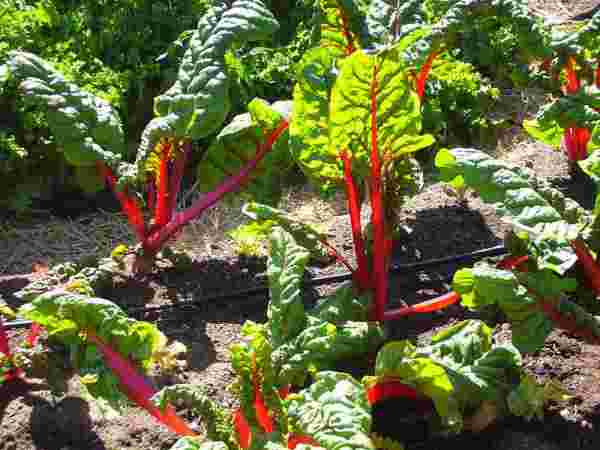
Photo by mercedesfromtheeighties.
Sponsored Links
Swiss Chard — Nutritional Analysis
- Nutrient
- Units
- Value / 100 g
- Proximates
- Water
- g
- 92.66
- Energy
- kcal
- 19
- Energy
- kj
- 79
- Protein
- g
- 1.80
- Total lipid (fat)
- g
- 0.20
- Ash
- g
- 1.60
- Carbohydrate, by difference
- g
- 3.74
- Fiber, total dietary
- g
- 1.6
- Minerals
- Calcium, Ca
- mg
- 51
- Iron, Fe
- mg
- 1.80
- Magnesium, Mg
- mg
- 81
- Phosphorus, P
- mg
- 46
- Potassium, K
- mg
- 379
- Sodium, Na
- mg
- 213
- Zinc, Zn
- mg
- 0.36
- Copper, Cu
- mg
- 0.179
- Manganese, Mn
- mg
- 0.366
- Selenium, Se
- mcg
- 0.9
- Vitamins
- Vitamin C, total ascorbic acid
- mg
- 30.0
- Thiamin
- mg
- 0.040
- Riboflavin
- mg
- 0.090
- Niacin
- mg
- 0.400
- Pantothenic acid
- mg
- 0.172
- Vitamin B-6
- mg
- 0.099
- Folate, total
- mcg
- 14
- Folic acid
- mcg
- 0
- Folate, food
- mcg
- 14
- Folate, DFE
- mcg_DFE
- 14
- Vitamin B-12
- mcg
- 0.00
- Vitamin A, IU
- IU
- 3300
- Retinol
- mcg
- 0
- Vitamin A, RAE
- mcg_RAE
- 165
- Vitamin E
- mg_ATE
- 1.890
- Amino Acids
- Tryptophan
- g
- 0.017
- Threonine
- g
- 0.083
- Isoleucine
- g
- 0.147
- Leucine
- g
- 0.130
- Lysine
- g
- 0.099
- Methionine
- g
- 0.019
- Phenylalanine
- g
- 0.110
- Valine
- g
- 0.110
- Arginine
- g
- 0.117
- Histidine
- g
- 0.036
Have you been wanting to do hatha yoga (stretching) but have found it either too difficult or you are not that flexible? If yes, and even if no, watch Jesse do some pure hatha yoga routines.
Unlike flow yoga
, each pose in pure or traditional hatha yoga is held for a few minutes. While holding the pose, you focus the mind on the stretch. When you focus the mind, that's when you find silence.
Jesse is not flexible — never has been and probably never will be flexible like others. But it doesn't matter. In pure hatha yoga, how flexible you are makes no difference. It's all about loving the pose and focussing the mind on the stretch.
If you want to learn pure hatha yoga, now you can by following Jesse on a series of hatha yoga routines.
Sponsored Links
Random Questions That Have Been Asked:
- What is the healthiest juice I can make?
- Juicing and Weight Loss
- Did not realize that pears and beets are high in sugar!
- Receding Gums and Juicing
- I Got Ill, For A Short Time, While Juicing
- Juicing Gave Me An Upset Stomach
- What Vegetables or Fruits Can Help With Soft Stools or Diarrhea?
- What Do You Recommend for high blood pressure and high cholesterol?
- Juicing Combination Review
- Please comment on a report that says beet juice can improve exercise endurance?